




How to Use ‘Who’ vs. ‘Whom’
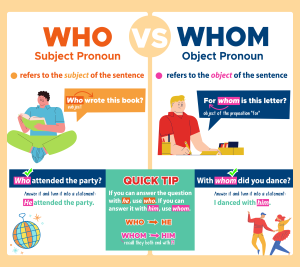
how to use who vs whom “Who” refers to the person doing an action. “Whom” refers to the person receiving it. In grammar, “who” is a subject and “whom” is an object. In formal writing, use “whom” after a preposition.
“Whom” can sound stiff in everyday speech. In many cases, “who” sounds more natural and remains acceptable.
The Basic Difference Between how to use who vs whom
“Whom” is the objective form of “who.” Use it when the pronoun receives a verb’s action or follows a preposition.
An object can be a noun, pronoun, gerund, or clause. It may receive a verb’s action or complete a preposition’s meaning:
- They bought a sandwich. “Sandwich” receives the action of “bought.”
- My dog ate it. “It” receives the action of “ate.”
- An appropriate time for apologizing. “Apologizing” follows the preposition “for.”
- I was afraid that it was true. The clause completes the meaning of “afraid.”
“Who” is a pronoun. It stands in for a person or group. Use “whom” when that pronoun fills an object position.
“Who” and “Whom” in Questions
Use “Who” for the Person Doing the Action
Who told my dog about that sandwich?
Turn it into a statement: “X told my dog about that sandwich.” X performs the action, so “who” is the subject and the correct choice.
Use “Whom” for the Object of a Preposition
Who should my dog apologize to?
Turn it into a statement: “My dog should apologize to X.” X follows the preposition “to,” so “whom” is the formal choice:
Whom should my dog apologize to?
You can also move the preposition to the start of the question:
To whom should my dog apologize?
The version with “to” at the end is also grammatical. In casual speech, many people use “who” in either version.
“Who” and “Whom” as Relative Pronouns
Relative pronouns refer to a person or thing mentioned earlier. They also introduce a clause that describes it.
Use “Who” When the Person Does the Action
The person who told my dog about the sandwich was unhelpful.
The clause “who told my dog about the sandwich” describes “the person.” That person does the telling, so “who” is correct.
Use “Whom” When the Person Receives the Action
The sandwich’s owner, who my dog apologized to, requires a replacement sandwich.
In the clause “my dog apologized to the sandwich’s owner,” the owner follows the preposition “to.” The formal version uses “whom”:
The sandwich’s owner, whom my dog apologized to, requires a replacement sandwich.
You can also write:
The sandwich’s owner, to whom my dog apologized, requires a replacement sandwich.
More Examples
“Who” as the Subject
According to my cat, who witnessed the sandwich incident, the sandwich seemed abandoned.
The clause says “my cat witnessed the sandwich incident.” The cat does the witnessing, so “who” is correct.
“Whom” as the Object of a Verb
My cat, who I was eager to believe, has a habit of fibbing.
The clause means “I was eager to believe my cat.” The cat receives the action of “believe,” so the formal version uses “whom”:
My cat, whom I was eager to believe, has a habit of fibbing.
When the Sentence Structure Gets Complicated
Consider this sentence:
I know that who is on the cat’s good side always matters in such cases.
The clause “who is on the cat’s good side” acts as the subject of “matters.” Inside that clause, “who” is the subject of “is.” So “who” is correct, even though it appears after “know.”
Break a sentence into smaller clauses to find the subject and object. Ask who performs the action and who receives it.
Trust Your Ear
Use “who” for the person doing the action. Use “whom” for the person receiving it or following a preposition.
When “whom” sounds stiff, “who” often feels more natural in conversation. English usage is flexible, so trust your ear when the formal choice sounds awkward.
Keeping “who” and “whom” in their prescribed places can feel as hard as keeping a dog away from an unattended sandwich.

Leave a comment